Welcome to UKOLN's Cultural Heritage blog. This blog was launched in early 2009. The blog complements UKOLN's range of services for the cultural heritage sector and provides a dissemination channel as well as a forum for discussions and debate.
This is your last chance to sign up for the free one-day workshop entitled ‘An Introduction to Web 2.0 and the Social Web’ sponsored by the MLA. The workshop be looking at what can Web 2.0 and the Social Web offer to museums, libraries and archives, especially small organisations with limited budgets and technical expertise.
There are quite a number of papers which are likely to be of interest, covering the conference themes of Digital library applications & interactive Web and Sustainable policies for digital culture preservation. In addition to these to these papers, the speakers slidesarealso available, together with the slides for invited presentations.
That’s the good news. The bad news is that these resources are only available on the conference Web site, and only in PDF format. So that slides haven’t been uploaded to a slide-sharing service such as Slideshare or Authorstream which would enable the resources to be embedded elsewhere (such as in blog posts). And since the original format for the slides (which was almost universally PowerPoint) is not available, it would be difficult for the slides to be reused.
To have the slides hosted on the conference Web site is sensible – for the slides for a conference which had a strong focus on Web 2.0 not to make use of a service such as Slideshare to enable this content to be more easily reused is, I feel, a mistake.
A blog was also used to support the conference – but despite the calls for speakers and delegates to make use of the blog, only six posts were published. The blog was used, however, to provide access to abstracts of the papers and speaker details.
We can now tell you about four more Web 2.0 Workshop dates for 2010.
The one-day workshop sponsored by the MLA and entitled ‘An Introduction to Web 2.0 and the Social Web’ will be looking at what, if anything, can Web 2.0 and the Social Web offer to museums, libraries and archives, especially small organisations with limited budgets and technical expertise.
The Museums, Libraries and Archives Council (MLA) have published a new set of Web pages highlighting their policy for the Digital agenda in libraries, archives and museums.
The Museums, Libraries and Archives Sector has an important role to play in using digital technologies to deliver improved access, increased information and more opportunities for participation in its rich diversity of resources and services.
MLA is committed to helping museums, libraries and archives make full use of these opportunities, and to ensuring that the sector is at the heart of government digital policies.
Our role is to provide strategic leadership to the sector in relation to the digital agenda through:
Developing a vision for the sector’s use of digital technologies
Supporting and promoting the development of quality standards
Encouraging innovation to enable inclusion of all communities
Promoting understanding and skills development
MLA has commissioned digital services from a number of organisations to help to deliver:
More and better quality information on cultural opportunities to the public
A coherent portal for cultural resources for teachers and learners
Greater interaction with individuals and communities through use of Web 2.0 and social networking tools
High quality standards in the management and preservation of digital resources
UKOLN will be working with MLA on this digital agenda and an overview of the digital services commissioned is now available.
Further information on the social Web workshops we will be running is also now available. More information on venues and dates will follow.
The international conference for culture and heritage on-line has just opened its call for participation. Next year’s event will run from April 13-17 in Denver, Colorado, USA.
Museums and the Web explores the social, cultural, design, technological, economic, and organizational issues of culture, science and heritage on-line. Taking an international perspective, MW reviews and analyzes the issues and impacts of networked cultural, natural and scientific heritage. Our community has been meeting since 1997, imagining, tracking, analyzing, and influencing the role museums play on the Web.
This workshop will offer practical experiences on issues of using social media in your library. Starting a blog, deciding to microblog and contributing to social networks are relatively simple: Setting policies and procedures, choosing tools and measuring the impact are not. Learn how to measure the success of your social networking efforts, focusing on user feedback, return on investment and impact assessment. Is organisational rather than individual use a sensible approach? The session will provide advice on best practices on the use of social networking services in an organisational context.
I was pleased to have been invited to speak at the annual conference organised by the Association of Independent Museums (AIM). The AIM 2009 conference was held at the National Waterways Museum, Ellesmere Port with the theme of “Volunteering in the Independent Museum“.
My talk, entitled “Benefits of the Social Web: How Can It Help My Museum?”, fitted in nicely with this theme in exploring ways in which social networking services could be exploiting by museums, in particular small museums with limited resources and technical expertise.
My slides, which are available on Slideshare and embedded below, provided a number of examples on how the Social Web is being used by a number of cultural heritage organisations.
My talk concluded by mentioning some of the challenges which need to be addressed in order to make effective use of the Social Web. In the afternoon I facilitated two hour-long workshop sessions which provided an opportunity to discuss these challenges in more detail.
One particular challenge which was raised in both sessions was how does one choose which service to engage with, as there are so many options available. :I suggested that one important technology to explore was RSS (Really Simple Syndication) as this would enable content on a small Web site to be made available (syndicated) elsewhere, either on other Web sites or on mobile devices. And a good way of gaining a better understanding of RSS (which many participants appeared to be unaware of) was to make use of a simple RSS reader such as Netvibes or PageFlakes.
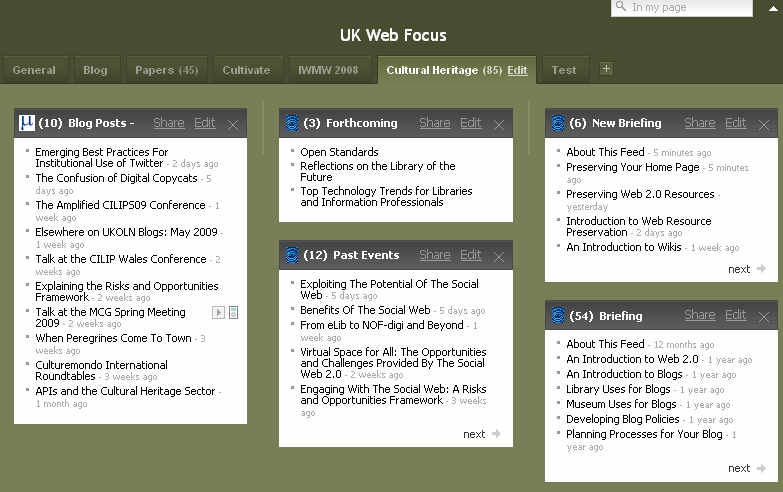
Use this, I suggested, to view relevant RSS feeds which might include resources from similar museums which are already providing RSS feeds, resources from funding organisation, blog posts form the msueums sector and even areas of personal interest (the BBC news site provides a range of RSS feeds). And once you have appreciated the benefit of dynamic content coming to your rather than having to visit Web sites to see if anything new is available you should then be motivated to create RSS feeds for your own institution. And if you’re still unclear as to how Netvibes can be used, have a look at the Netvibes page which brings together dynamic content about UKOLN’s cultural heritage resources, which is also illustrated below.
But how would you go about creating RSS feeds? One approach is to make use of Socuial Web applications such as blogs and resources sharing services (e.g. Flickr) as these will normally provide RSS feeds or other syndication mechanisms as standard.
Last week I attended the CILIP Scotland 2009 conference which was held at the Peebles Hydro, Peebles. This conference built on the experiences gained from the ‘amplification’ of the recent CILIP Wales conference. The tag for the event (#cilips09) was used to aggregate tweets about the conference. In addition the Coveritelive live-blogging service (illustrated) was used to complement use of Twitter – this has the potential to allow comments to be made by people who do not have (or wish to have) a Twitter account.
Following the positive feedback I received from making available a video recording of my talk at the CILIP Wales conference I repeated this at the Scottish event. In addition as I was able to make use of Skype at the conference I asked my Twitter followers if anyone was interested in participating remotely. Ian Edelman responded and, as described in his blog post, found that being able to listen to a talk from afar had benefits, although there were a couple of areas in which improvements could be made.
Once again, for those who could not attend the conference or for those who were at the conference but attending the parallel session, my slides for the talk on ”From eLib to NOF-digi and Beyond“ are available on Slideshare (and embedded below).