Patients Participate!

The blog for the JISC-funded Patients Participate! project. Community Content for Participative Medicine: A Feasibility Study.

Open Research Reports

I’ve just heard about the Open Research Reports initiative, an idea to make disease research as openly accessible as possible to the people that really need it.

Open Research Reports aim to pull together the corpus of open access literature on a certain disease and also create a mechanism of extracting the important information from closed access papers to generate an open summary.

The idea will be discussed at the Open Science Summit, with a Semantic Web Applications and Tools for Life Sciences Hackathon in December. Links to more information and registration are available in a blog post

A comment on that blog post also brings to light another related initiative, described as a repository of evolving reviews on research topics on RocketHub linked to the SciFund Challenge.

Scenarios for writing lay summaries

In preparation for the workshop, the project constructed a number of scenarios to help think through examples of how web-based, biomedical information resources, technologies and communities could support translation of emerging research findings into plain English. These scenarios were not intended as suggested services, but rather the aim was to stimulate group discussion and invite feedback. These scenarios are completely hypothetical and are not trying to illustrate how a specific service should be built. They are used to draw out questions and issues around the idea of producing lay-summaries through a crowd-sourcing approach, and this is the spirit in which they are being shared, together with some of the questions raised.

Scenario 1: A patient writes a lay summary which is then published and shared

A patient who has been writing lay summaries for six months logs into the literature review system to look for articles that he can write about, in order to share them with other patients. The patient consults the queue of reviews suggested to him on his home page. These have been selected by the system by matching new articles to a list of topics of interest that the patient had written in his profile. The patient selects one of the papers, a report on a trial of a new drug, by reading the abstract, and then follows a link to read the full paper. Having read the paper, the patient then fills in a form which suggests questions and sections that help to summarise the research. Other tools, like a glossary, are available to help. The patient completes the summary, it is marked as finished and then becomes public. The patient reflects on the outcome of this new research and makes a mental note to ask his consultant about the new medications at his next treatment review. Before logging out, the patient spots a new message in his notification area, which advertises the next training session for writers of lay summaries. The patient remembers the last training session where he met other lay summary writers that he now keeps in touch with through the discussion forum, and he considers signing up.

Questions

How should information (lay summaries) be generated, are there accepted methodologies and best practice in this area?
Would this necessitate training and support?
Who should write lay summaries? What are the risks of blurring the division between the amateur and the professional?
What training is needed, and who is going to provide training? How are lay summary writers recruited and trained? (e.g. training methods: open days, shadowing researchers, specific training, handbooks, joint training; recruiting methods: through service users panels, advertising in national newspapers, through charity websites and forums, using links with service managers, websites dedicated to Public Patient Involvement – PPI)
What methods would be most suitable?
What features and tools are needed in a system supporting the writing of lay summaries?
How much guidance would be required to write a lay summary?
Could this guidance be in the form of questions or sections to be filled in about the research?
How are writers matched up with the articles that they summarise?
To what extent are authentication and authorisation systems required? Is there a role for anonymity, and how could this impact trust and quality?
What about issues of privacy?
Is a review process for lay summaries needed before it is shared with others? Who is responsible for editorial control and how is quality maintained? Would this type of activity need to be moderated in some way?
What other benefits could patient writers of lay summaries gain from becoming involved in the activity e.g. gaining of new skills through the training, being better acquainted with the literature,improved understanding, increased interest in research, support gained through building up social networks and other social contact, confidence to participate in other forms of on-line activities like discussions, empowerment through being active participants, inclusivity.
Could lay summaries be used to help connect users with shared interests, and how would they integrate with other online systems that patients use socially?
Where and in which communities do patients and potential lay summary writers already have an on-line presence, how can these be harnessed to build a community around the lay summary writing process?

Scenario 2: A patient advocate reads lay summaries and rates the content.

A patient advocate wants to look at recent research in order to stay up to date with developments in his disease area. Later in the week he will be delivering a talk at an event organised by the charity that he supports to an audience of patients, and his diary for that week also includes a funding review meeting where the research areas for the next call for projects will be discussed. He carries out a search on PubMedCentral using the key words that he has learnt produce the best results for the most relevant research, and asks for items added in the last six months. When the results are returned he sorts them so that the ones flagged as having lay summaries are listed first. He reads through the lay summaries, and for each one that he reads, he provides a rating on a scale which asks (1) how useful the summary was to him and (2) was it easy to understand. He then looks at the next batch of results that do not have any lay summaries. Two of them catch his eye and although he is now running out of time and is almost late for his next appointment, he clicks on the button that pushes the two studies up in the queue for the articles with most requests for lay summaries.

Questions

Who will be reading lay summaries?
What motivates different types of user to look for biomedical information?
How do different communities decide what sources are ‘trusted’ and how is quality decided? What is the definition of quality? (e.g. accurately reflects the research, language is understandable by the proposed readers).
How can charities make use of lay summaries?
What could be the impact of availability of summaries on research funding decisions?
How will lay summaries be discovered?
How can they be presented alongside the original article?
What features are needed in systems providing lay summaries? (e.g. ability to rate summaries, different ways of searching and ranking, how to prioritise articles to be summarised)
Should lay summaries be rated? What sort of ratings would be useful?
Who will be evaluating lay summaries, and how?
What are the key factors for the way biomedical information is presented that enable easy comprehension by a range of people? And what would motivate them to revisit one information resource over another?
What would be the strongest motivators for different groups to produce this type of information (incentives eg credit/visibility or sanctions/mandates)?

Scenario 3: An academic reviews lay summaries written for papers she has published.

An academic wants to find out if any lay summaries have been published for her most recent work in order to evaluate the lay review and make a note of it. The academic checks her inbox and sees that she has received an email notification of new reviews. She uses the links which lead her to the lay summaries. She logs in and identifies herself as the author of the paper; there is a box which allows her to mark that the lay summary is considered to be an accurate representation of the research. She notices that some of the reviews have been rated as 5* for their usefulness and that the lay summaries have been read over 200 times. She makes a mental note to mention this as a measure of the impact of her work in her upcoming staff development review meeting with the Head of Research in her department. Before logging out she notices that one of the summaries has a flag that shows that there are questions posed by patients in the discussion group relevant to that research article. The lay summary had been written by TrustMeI’mAPatient (real life name: Paul), one of the most active of the lay summary writers, whose profile shows that his summaries have high ratings for both usefulness and quality. A link takes her to a discussion group and she engages with the thread, answering some of the questions asked about details of her research, and suggesting some other articles that the patients may also wish to read. While still on the system she scans to see which other lay summaries have been written in the her research area, and finds it interesting to note some trends in the most popular articles, and thinks there may be a link with the main areas of interest highlighted in the latest call from one of the charities that funds her research.

Questions

Who should write and review lay summaries?
What procedures to ensure quality should be put in place?
How do users of lay summaries make judgments of quality and trust based on the presentation of lay summaries, and issues such as readibility and accuracy?
How are academics included in the work flow of lay summary production? Which aspects of the workflows of academics does the lay summary system need to fit in with?
What would be the impact on the work load of academics who need to write or review them?
What feedback do researchers want on the lay summaries related to their research?
What are the effects on impact of the research? What could be the impact on making research better-known and better-used by different stakeholders?
Could lay summaries lead to better quality research? Or have an impact on research ethical practice?
Do researchers think that their research will have more impact if it is made available to patients as lay summaries?
What concerns could academics have around the impact that lay summaries have on their chances of getting further funding for research?
What could the writing and reading of lay summaries tell us about which research is important to patients?
How could statistics on lay summaries be used to provide feedback to academics on the impact of their work?
What role could lay summaries play in improving communication between researchers and patients? How might this scenario effect researcher-patient relationships?
What opportunities do lay summaries present for researchers to engage with the patients that their research affects? What could be the positive consequences e.g. the views of researchers could change as a result of engaging with patients, they could gain a clearer understanding of patient views or be more motivated.
What could be the impact of lay summaries on the directions of future funding of research?
What assumptions do we need to question?

Scenario 4: A charity notifies its members of new research in their field

A charity communications officer is reviewing the ‘latest research’ newsfeed that is displayed on the main home page of the research charity website. He is pleased to find notification about several new lay summaries all in the disease area that is of interest to the members of the charity, and that some of them are derived from some papers that were recently published by research teams funded by the charity. The charity communications officer remembers submitting those articles to the lay summary writing system so that they would be suggested to the lay summary writers for review. He clicks the button that will publish these new reviews in the newstream on the charity website. Before finishing for the day, he places the advert in the newspaper that advertises the next round of training and recruitment for lay summary writers.

Questions

How do lay summaries fit into the other channels of communications that charities use?
What sort of impact could they have e.g. drive traffic to charity websites, increased demand and requests for further information or assistance.
What other systems used by charities do the lay summaries need to integrate with?
How are lay summary reviewers selected? What involvement would be required from charities?
How are articled prioritised for writing lay summaries and what would be the role for charities?
What could be the impact on charities in making the research that they fund better known and more accessible?
What is the benefit of bringing in new voices to the conversations around research?
Would lay summaries help patients to be in a better position to contribute to shaping research strategy and taking part in activities such as peer review, areas in which charities are already involving patients.
Are there models and experience that would help inform charities on how to take this forward?
Where could lay summaries make a greatest difference to the current activities of charities?
What will other internal and external stakeholders of charities think, and how could they be affected?

Scenario 5: Tool builders carry out a user focus group meeting

The web team for the lay review system meet for their weekly planning meeting. Some of them have been looking at the system logs and they have noticed a trend that the lay summaries that are associated with articles which are freely available are more frequently read and rated than those which are behind subscription firewalls. The logs also provide some insight into areas of the website that are well-used and others that appear underused, and some frequently-occuring user errors are also reported. In addition, an email has been received by the web-team from an irate academic who complains that a lay summary of one his articles is incorrect. A decision is made that the summary in question will temporarily be made invisible pending review; this email needs to be passed on to the other teams as the web team are not qualified to judge issues of content quality; however a note is made that perhaps the system requires a feature to help facilitate communication to help resolve such issues as the web team is not the best team to be contacted regarding this. Two team members also reports on a focus group held with lay summary reviewers who provided feedback on some aspects of the user interface and made suggestions for improvement. The focus group participants had also commented on the form that is used to guide the writing of the lay summary as they think it needs some changes. The leader of the team adds this to the list of items that need to be passed on to other teams in the charity who will be able to review the summary-writing form with researchers and lay summary writers. The team discuss dates to plan the next user focus group meeting which will be needed before any of the changes to the interface and the form can be made live.

Questions

How are issues of quality of lay summaries dealt with?
How do we ensure quality of information and how do we avoid propagating incorrect information? (Editorial control and approvals process)
What are the different responsibilities of publishers, charities, service providers? What new roles may be required to manage a lay summary system?
How will the systems be evaluated? What evaluation is needed? (functionality, usability, impact) How can the impact be measured? Need to consider impact on patients, researchers, charities/funders…. how can evidence be collected?
What features are needed in the lay summary system to enable users from all stakeholder groups to provide feedback?
What would make a lay-summary system easy to use?
What is the impact of open access and pay walls?
How could the different communities work together eg patients, charities and researchers in enabling access to and facilitating translation of biomedical information?
What are the different interface design and usability issues associated with the different levels of knowledge, expectation and need?
Who owns the IPR over the summaries? Should they be open access? What are the rights over their re-use? (by charities, researchers). What sort of access-control should be applied? (e.g. registration only, pay-only)

The acawiki.org project

The project with the closest idea to that being investigated in Patients Participate! that we have identified so far is the acawiki.org site. It is a general site run on a wiki platform, that invites summaries of academic articles to make them more accessible. “AcaWiki is building a community of scholars, graduate students, and bloggers to write summaries of papers that are of the most general interest to the public”

Acawiki recently announceda summer project to gather summaries for the top 100 academic papers around the world. They are calling for volunteers to help them reach this target. Can you help?

The logo for acawiki

Presentations from the workshop.

The presentations from the workshop are now available from slideshare. These are in addition to the recording of Liz Lyon opening the event.


.prezi-player { width: 550px; } .prezi-player-links { text-align: center; }


The presentation by Graham Steel is available on Prezi: Patients Anticipate and Simon Denegri has described his talk in a blog post.

Workshop Speakers

At the workshop I managed to record the welcome and introduction to the project by Liz Lyon using a Flip camera, and this is now available from vimeo. Warning: there is flash photography which can be seen in the recording.

Liz Lyon opening the Patients Participate! Workshop, Jun 2011 from UKOLN on Vimeo.

The Biographies for all of the speakers at the Patients Participate Workshop are as follows:

Dr Liz Lyon is Director of UKOLN, University of Bath, and Associate Director, Digital Curation Centre. She is author of major direction-setting Reports: Open Science at Web-Scale: Optimising Participation and Predictive Potential (2009), Scaling Up (2008) and Dealing with Data (2007), and has led pioneering research data management projects: eBank, eCrystals Federation, Infrastructure for Integration in Structural Sciences (I2S2) and SageCite. She has a PhD in cellular biochemistry.

Dr Lee-Ann Coleman joined the British Library in 2007 to take up the post of Head of Scientific, Technical and Medical Information. For ten years prior to that, she worked in science policy and administration, and gained experience in the funding, university and medical research charity sectors. She has a PhD from the University of Western Australia where she studied the development of the visual system and completed postdoctoral research in the United States and at Oxford before moving into scientific administration.

Dr Sara Ellis is communications manager at the Association of Medical Research Charities (AMRC) where she supports the team on print, online and media communications. Sara has a PhD in biochemistry from the University of Bristol and spent seven years in the lab as a researcher before crossing over into the charity sector. Sara hates jargon, although sometimes is guilty of it, loves clear communication and is particularly interested in social media.

Professor Melanie Welham started her scientific career as an undergraduate in Biochemistry at Imperial College, London and moved to the Imperial Cancer Research Fund for her PhD. After several years of post-doctoral research at The Biomedical Research Centre, University of British Columbia, in Vancouver, Canada, Melanie was appointed to a Lectureship in the Department of Pharmacy and Pharmacology, University of Bath, where she is now Professor of Molecular Signalling and co-Director of the University’s Centre for Regenerative Medicine. She leads a team of researchers whose focus is on investigating the behaviour and biology of stem cells, work initiated during her time as a BBSRC Research Development Fellowship (2003-2006). In her alternate career, Melanie cares for two daughters, a husband and three guinea pigs!

Graham Steel has been actively involved in Patient Advocacy work in his spare time since 2001. Graham acted as Vice-Chairman for a UK Charity, the Human BSE Foundation 2001 – 2005 and then as Information Resource Manager for the CJD International Support Alliance (CJDISA) 2005 – 2007. More recently, his activities have been focused mainly on Neurodegenerative conditions such as Motor Neurone Disease. He is also involved in advocating for Open Access/Science/Data and acts in advisory capacities to the Open Knowledge Foundation, the Public Library of Science (PLoS) and most recently, Digital Science.

Simon Denegri is chief executive of Ovarian Cancer Action. Before taking up this appointment in June 2011, he spent five years as chief executive of the Association of Medical Research Priorities (AMRC). Simon was appointed chair of INVOLVE – the national advisory group for the promotion and support of public involvement – in May 2011.  He is also a member of the National Institute for Health Research (NIHR) Advisory Board, the NIHR Strategy Board and the UK Clinical Research Collaboration (UKCRC) Board. He has written and spoken extensively on issues concerning medical and health research policy and practice and writes a popular blog on the world of medical research, charities, public engagement and involvement: http://simondenegri.com/

After the workshop: a thank you.

The project team would like to thank all those who came to the Patients Participate! workshop on Friday 17th June 2011.  We are very encouraged by the level of attendance and engagement during the event.  We are very appreciative of the information and views we have gathered through your input, and we will be producing a report on the outcome as a project deliverable.  In the meantime, here is the collection of tweets from the day as stored on TwapperKeeper.

A sample of the tweets giving a flavour of what some of the participants made of the workshop:

“Thank you @ScienceBL for very informative workshop on Patient Participation #jiscpp.”

“Interesting stuff being tweeted on #jiscpp about helping patients access medical literature. Thanks @JoBrodie for mentioning our approuch”

“Excellent #jiscpp Patients Participate! workshop at British Library Conference Centre today. Will blog later …”

“The excellent discussions from #jiscpp, archived in Tweets by @JoBrodie: http://bit.ly/kWYyhu

“Have just installed”Hyperwords” http://t.co/Utl0ebC following the demo at#JISCPP

“Interesting and informative day at Patients Participate! #JISCPP

A big thank you goes especially to top twitterer Jo Brodie from Diabetes UK.  Jo created a ChirpStory (a tool for creating and sharing stories from Twitter, which had hit 100 views by Monday) and a storify view of the day.  Statistics of the tweets from the workshop have been generated using summarizr and the following screen shot gives an overview of the tweets, as analysed by the summarizr service:

Blog reports are starting to appear, here is a selection.  Let us know if you have written your own blog post and we will add it to the list.

http://inthelandofnewnormal.blogspot.com/2011/06/patients-participate.html – a really good overview of the content of the talks and breakout group exercises.

Simon Denegri has summarised his talk in a blog post Democratising Research. (Simon helped to put the bid together to fund the Patients Participate! project while he was at AMRC, and was one of our closing speakers.) Graham Steel’s presentation is already available on Prezi.

Finally, a thank you to all our speakers  (we will be adding a clip of Liz Lyon opening the workshop in our next post, together with biographies of all the speakers) and congratulations to the British Library, who were in charge of organisation and made everything run smoothly.  Here is a picture of Karen Walshe (from the BL) with Sara Ellis (who spoke on behalf of the AMRC) and our guest speaker giving the patient advocate perspective, Graham Steel (@McDawg)

Karen Walshe, Sara Ellis and Graham Steel before the start of the workshop.

The Patients Participate! Workshop

Bridging the Gap between Information Access and Understanding in Health Research

17 June 2011

The British Library Conference Centre


We now have more access than ever to scientific papers and summaries of biomedical and health research. Anyone with a computer and an internet connection can read the latest research results due to initiatives like UK PubMed Central which provides free access to scientific peer-reviewed papers.

Having access to the information does not always help patients or the public make sense of scientific research. This workshop will examine ways that we might address the gap, through the development of ‘community content’ and the application of web technologies that might help people to make sense of the science.

We want to bring together people from different communities- patients, carers, researchers, charities, and technologists– to explore what the motivations, challenges and barriers to biomedical information access, comprehension, and wider use are. We hope to develop new ideas to enable the opening up of publicly-available, scientific literature to a wider audience.

Twitter: #JISCPP

Workshop Programme

10:30 Registration and coffee

11:00 Welcome to the workshop

Liz Lyon (UKOLN, University of Bath) – Patients Participate: Origins and Overview

11:15 Introduction to the project from the project partners

Lee-Ann Coleman (British Library) – Accessing Biomedical and Health Information
Sara Ellis (Association of Medical Research Charities) – Patient Perspectives on Research Findings
Professor Melanie Welham (Centre for Regenerative Medicine, University of Bath) – Communicating Research Beyond Academia

11:45 Assigning workshop groups, brief introductions and setting questions

12:15 Lunch

13:00-3:20 Workshop groups (including afternoon tea break)

The workshop groups will explore what role web-based, biomedical information resources, technologies and communities can play in translating emerging research findings into plain English so that all those interested, are able to trust, understand and access biomedical and health information.

To help focus discussions, the broad and topical theme of stem cell research will be used.

The groups will be asked to share their views on what they like and don’t like for a range of resources, whether it be the way the information is presented, ease of use of the technology, or any other factors.

This will be structured around a set of questions and scenarios to help understand:

1. What motivates different types of user to look for biomedical information and to revisit one information resource over another?
2. What are the barriers – perceived or real – to online access to biomedical information?
3. What are the key factors for the way biomedical information is presented that enable easy comprehension by a range of people?
4. What are the types of web technologies that help people find and use biomedical information for their own specific purposes? What benefits have emerged from using online media?
5. What is the potential for particular communities, for example patients or carers, to make use of biomedical information already available online to support better and wider understanding of current collective knowledge?
6. How could the different communities work together eg patients, charities and researchers in enabling access to and facilitating translation of biomedical information?

Through the workshop we aim to produce a set of simple best-practice recommendations on how best to leverage different communities and tools to enhance the communication of biomedical research.  A key output will be a set of Citizen-Patient case studies documenting approaches to promote online engagement, access and community evaluation for non-professionals.

3:20 Feedback from workshop groups and Summary Recommendations (Liz Lyon)

Reporting from each workshop group on discussions aligned to 5 questions/recommendations under the broad themes of:

  • Motivations and Barriers
  • Good and Bad Examples
  • Potential for Improving and Collaborating

3:50 Final guest speakers & Q&A

Graham Steel – Patients Like Me
Simon Denegri – Chief Executive, Ovarian Cancer Action & Chair Involve.

4:30 Close

Introducing the Project Partners: UKOLN

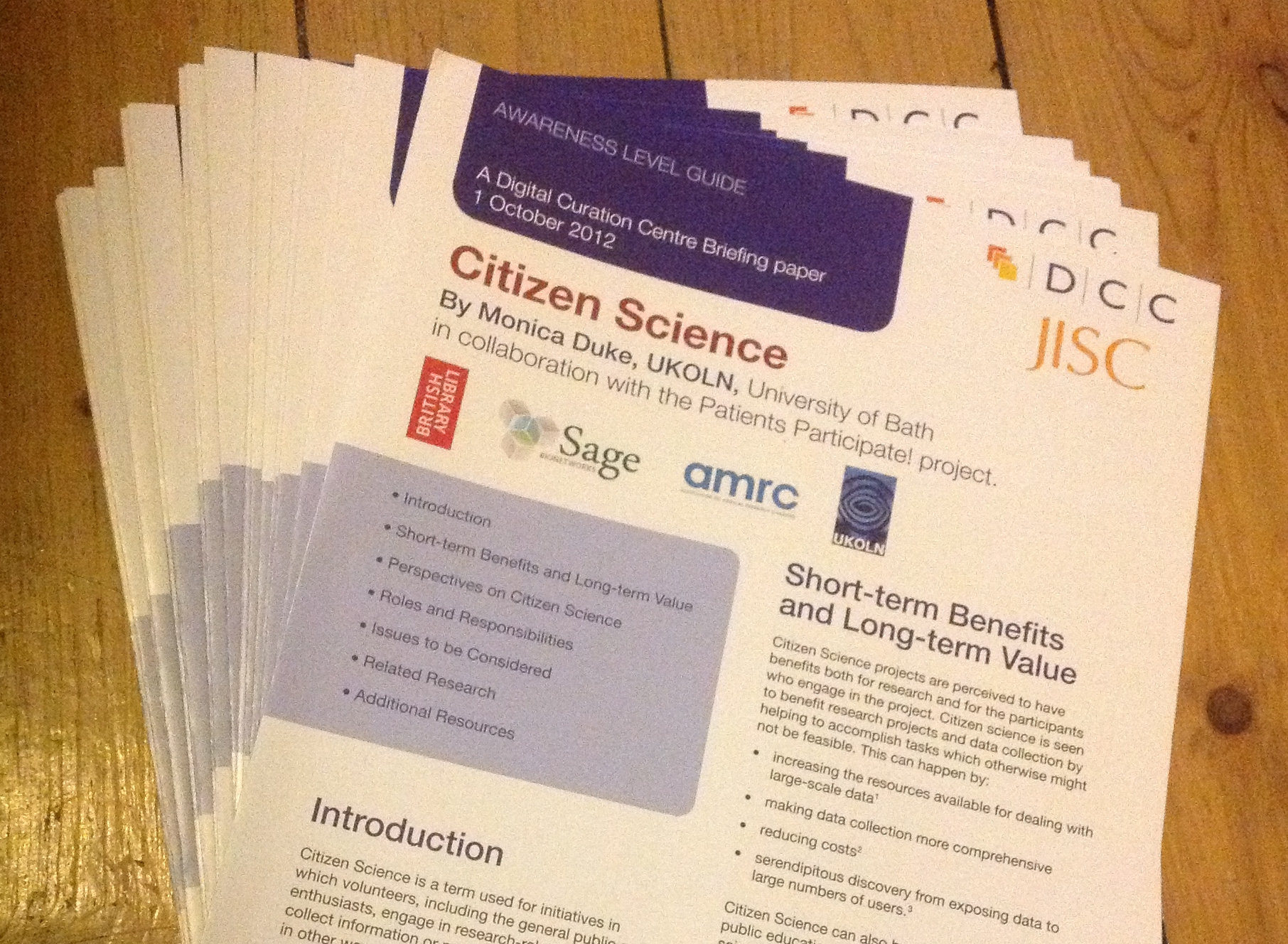
UKOLN LOGO The Open Science at Web Scale report published by UKOLN in 2009, discussed the possibility of engaging the public in science, by extending the science team to include interested volunteers or amateur scientists or citizens. Citizen Science is a term used for projects in which volunteers, including the general public and enthusiasts, engage in research-related tasks to collect information or participate in research in other ways. As well as increasing the resources available to research and helping to accomplish tasks that might otherwise not have been feasible, citizen science can also become a form of outreach to promote the public understanding of science [1].

The concept of collecting contributions from many individuals to achieve a goal is also called crowdsourcing. While the Open Science report provides examples of how this is happening in science, a New York Times blog post by Tina Rosenberg (Crowdsourcing a Better World) reveals many other ways where crowdsourcing has been applied, with a particular emphasis on contributions that help to bring about social change.

The Patients Participate! project brings together all of these three elements of citizen science:
- engaging patients with the researcher / academic community to produce interpretations of research that are friendly to patients (lay summaries),
- improving understanding of science by making research more accessible to lay people, and
- contributing to society by making sure that the information produced by researchers reaches those who have the most interest in the application of research results in health and medicine (ie patients), in a form that they can understand.

UKOLN is a centre of expertise in digital information management based at the University of Bath, UK, providing advice and services to the library, information, and education communities. We help to influence policy and inform practice, promote community-building and raise awareness, build innovative systems and act as an agent to transfer knowledge. We also undertake some research and development. We have worked with academics in higher education in areas as diverse as managing their research data and making their publications openly available through databases based at their institutions (called repositories) and have provided advice on how to use technologies like twitter to enhance participation in events. UKOLN is funded by the UK Joint Information Systems Committee (JISC) as well as project funding. JISC are funding the Patients Participate! Project.

Besides providing project management, in this particular project we are interested in investigating the potential for crowdsourcing to be applied to making information produced by researchers more accessible to the general public and particularly patients. We will be evaluating the software platforms (i.e. the tools) that are used in citizen science, asking questions about how they work and thinking about ways in which they could be used in the production of lay summaries. We will be working with academics to produce guidelines so that academics are better equipped to participate in citizen science initiatives that involve working with patients. Our health and medicine focus area is associated with stem cell research, and we will be working with academic colleagues in the Centre for Regenerative Medicine at the University of Bath.

[1] http://en.wikipedia.org/wiki/Citizen_science

Liz Lyon

Liz Lyon

Liz Lyon is Director of UKOLN and Associate Director, Digital Curation Centre.

Monica Duke

Monica Duke

Monica Duke is project manager for Patients Participate! and also provides some research effort.

Introducing the partners: The British Library

The stakeholders for Patients Participate! are spread across different communities: patients, charities, funders of research, researchers and policy makers (among others). The partnership that has been put together to carry out the project reflects the diverse interests that are represented in this project. Although all the organisations involved are household names in their own community, we recognise that they may not be so well known in other disciplines. The first posts in this blog represent a mini-series that we have put together to introduce the different parties, and their interest in the project. Lee-Ann Coleman starts us off by introducing The British Library.

One of the British Library’s strategic priorities is to ‘Enable access to everyone who wants to do research’; this project adds another dimension to the role of an information provider in achieving that aim. The Library has been the lead partner in a consortium delivering UK PubMed Central – the free-to-access archive of biomedical research papers – for the past five years. This service is supported by the eight major funders of biomedical research in the UK, with the intention that the research that they support (either through the tax payer or the donating public) should be available to anyone without the barrier of a further charge to access the information. There are over 2 million journal articles in UKPMC and it provides access to a further 24 million abstracts; all anyone needs is a computer and internet access – and a degree in biomedical science! Even those working in the field struggle to keep up with the volume of new information and if the research area is outside one’s expertise, it can often take significant time and effort to understand the context and the key messages contained within a research article.

So the question is can we involve the public and researchers in making sense of scientific concepts and terminologies to help them to understand the current state of research in specific areas? Stem cell research is an area that has a high profile in the media, with promises of cures for a range of diseases and the possibility of regenerating or replacing tissues and even whole organs. We are looking forward to working with patients, charities and researchers to better understand the barriers to extracting information that is useful to them from scientific papers and assessing the feasibility of building a corpus of quality content that is truly open to all.

Lee-Ann Coleman is Head of Scientific, Technical and Medical Information at the British Library.

Welcome to the Patients Participate! project blog

Hello and welcome. The patients Participate! project will be using this blog to announce project news and discuss items of relevance to the project. We hope that you will find it interesting to follow and that you will be able to feed back to our project through the comments on the blog. To learn more about the project please check out the about page.