
An Archive in the Palm of Your Hand
Posted by guestblogger on September 27th, 2010
About this Guest Post
Emma Faragher is an Education & Outreach Officer, at the National Library of Scotland (NLS), where she works on learning and interpretation for The John Murray Archive project. Emma can be contacted at e.faragher@nls.uk.
An Archive in the palm of your hand: The John Murray Archive app at the National Library of Scotland
The John Murray Archive exhibition at the National Library of Scotland exhibition highlights the archive of publishers John Murray. The archive records the business of the John Murray publishing firm, widely regarded as one of the world’s most important publishing archives. It comprises over 150,000 papers, manuscripts, letters and other documents representing many of the world’s most celebrated writers, thinkers, politicians, explorers, economists and scientists. The exhibition is an innovative interactive space which uses a mix of technology and theatre to bring a unique archive collection to life.
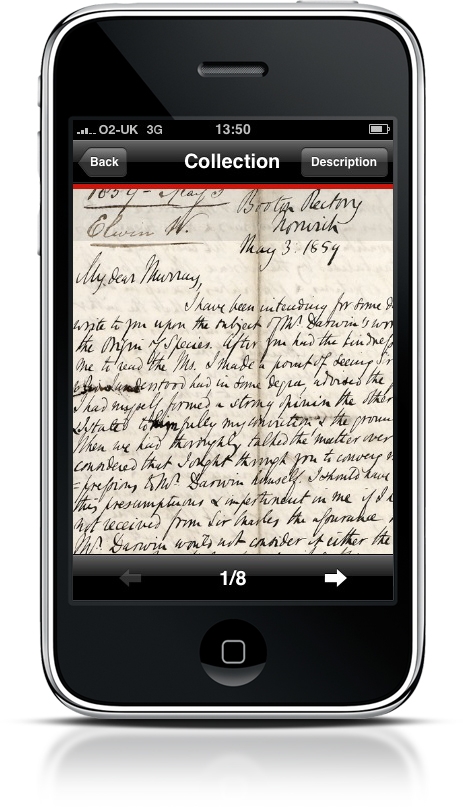
NLS iPhone app showing text from John Murray Archive
Originally the exhibition had an introductory film. However this was presented in a separate room and evaluation revealed that it was not well-used or understood by visitors. Therefore in 2009 NLS took the decision to remove the film and seek an alternative way to introduce the archive, deciding that this was a good opportunity to pilot the use of new technologies and handheld guides in our exhibition spaces.
Following a period of research and evaluation of existing handheld guides used in museums in the UK and further afield we decided to develop an ‘app’ for iPhone and iPod. At the time of our research this was still relatively unusual, though the popularity of apps as guides in the cultural sector has grown significantly since this project began, in tandem with the rapid growth of the mobile internet.
Development
The app was built with an external developer, Screenmedia. We built the app over a period of four and a half months. The team at Screenmedia worked with our Learning and Public Engagement team to develop a structure and content plan. We developed a themed structure which complements the archive’s website. Each theme includes an audio-visual introduction and access to a selection of documents. Content was developed with liaison from the curatorial team for the John Murray Archive.
Access & promotion

NLS iPhone app - interactive state
The app is available to the public in a number of ways:
- Remote users can download it from the Apple iTunes store, links have been provided to the store from John Murray Archive and main NLS websites.
- Visitors to NLS with an iPhone or iPod have the option to download to their own devices using our public wifi network.
- Visitors to NLS without their own device can borrow an iPod during their visit.
We have promoted the app using social media, including Twitter updates and Facebook and news streams on our website.
In addition we have used more traditional means of promotion, including a press release to local and national newspapers and more specialist press, receiving good coverage. We are also promoting the app in our public areas, including posters, café table tent cards and inclusion on information screens.
To date there have been almost 900 downloads of the app.
Evaluation
We receive monthly updates on downloads of the app which we map against promotional activity. This has already revealed that though social media promotion is valuable, traditional media still has its place – one of the greatest peaks in downloads was following the press release and subsequent publication of stories about the app in newspapers.
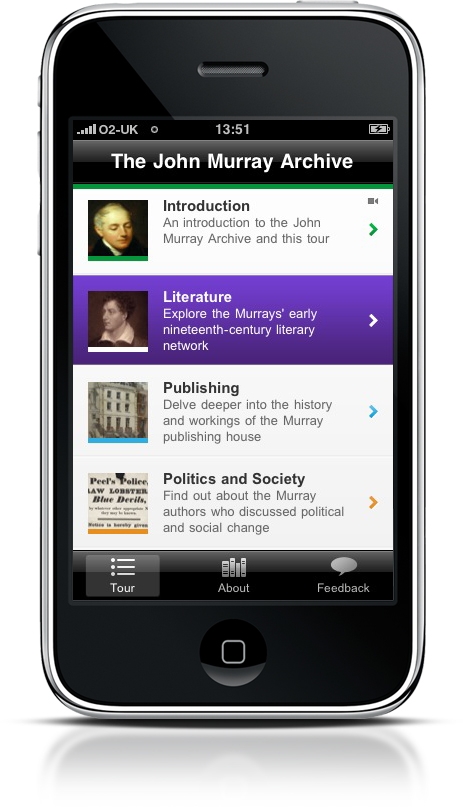
NLS iPhone app - rollover
We track star-ratings of the app following downloads, and have implemented an evaluation screen within the application itself which is linked to our wi-fi system so that people who use the app in the library can send feedback direct.
We are currently surveying visitors to NLS who use the app; initial returns have been very positive.
Some key learning points from the project
Our app began life as a project focussed on providing a service to exhibition visitors, but as soon as we selected our format it became apparent the service would also be of great potential interest to remote users. Therefore as the app developed we ensured that it would be interesting and relevant even if you are not physically at the Library. This has been borne out by the popularity of downloads for the app.
When this project was developed, iPhones dominated the smart phone market, but recent figures suggest that Google Android (the operating system used by a number of other smart phones) is likely to have an equal market share in the future. Further, the, advent of the iPad and tablet computers is likely to change the mobile internet market further in the next few years.
Remote users are increasingly important in our sector and as the popularity of mobile internet, smartphones and other tools develops they will offer many opportunities and tools for the cultural sector to engage with new audiences.
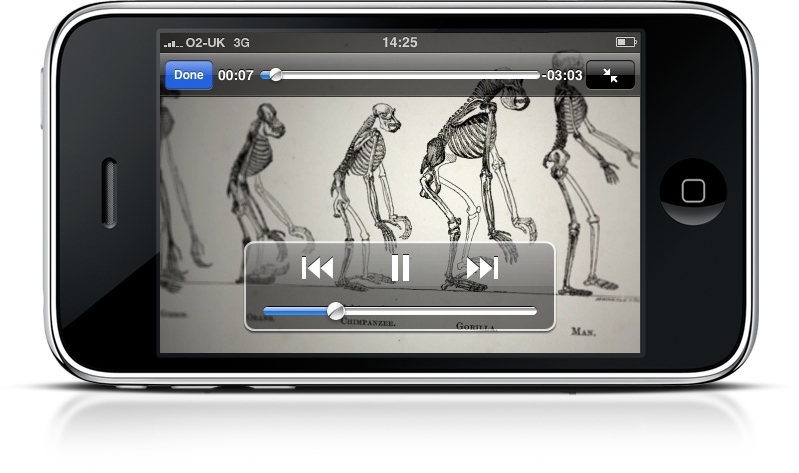
NLS iPhone app - video screen
September 28th, 2010 at 10:33 pm
[...] This post was mentioned on Twitter by Mies Langelaar, UKOLN MLA Support. UKOLN MLA Support said: An Archive in the Palm of Your Hand: About this Guest Post Emma Faragher is an Education & Outreach Officer, at th… http://bit.ly/d50e0c [...]