
Museums as Social Creatures
Posted by guestblogger on September 6th, 2010
About this Guest Post
Shona Carnall studied Museum Studies at Leicester University and since graduating she has been working at Hartlepool Cultural Services for nearly two years as an Education Officer. Shona specialises in e-Learning in a museum context and has added the museum to several social media websites including Twitter, Facebook and Audioboo. She recently wrote a case study for ‘Twitter for Museums: Strategies and Tactics for Success’ and her work on Twitter was mentioned by UKOLN’s Brian Kelly during a Radio 4 programme, ‘Making History’.
Museums as Social Creatures
Museums have always been institutes of learning and communication. A place where history can come alive and you can visit any part of the world. With the invention of the internet and digital media, people can explore the world without leaving the comfort of their own homes. Museums are now trying to find new ways to interact with their audience, and which has started to include going to where your audience is. Museums are becoming increasingly sociable, participating in conversations already taking place and this is where the internet can help.
Social media has become massive over the past couple of years with Facebook and Twitter becoming increasingly popular with the national and international population. Twitter particularly has grown rapidly from a few followers to over 25 million people registered with the microblogging service as of January 2010. Twitter allows people to get short, up-to the minute messages about what is happening around the world, with some of these messages reaching the general populous before traditional media. For museums, Twitter gives us a unique opportunity to contribute to conversations people are having online by going to them rather than trying to drive traffic towards us.
The Learning Team at the Hartlepool Cultural Services has been on Twitter since May 2009 under the guise of their mascot, Yuffy (@YuffyMOH). The aim of joining Twitter was to increase awareness of the Learning Team’s events particularly family events and to participate in conversations with interested members of the public. With over 1500 followers, and regular communication with followers, the scheme has been a success and one that will hopefully continue. The Learning Team’s presence on Twitter has been used as a case study in ‘Twitter For Museums’ book and mentioned on Radio 4 in the Making History programme.
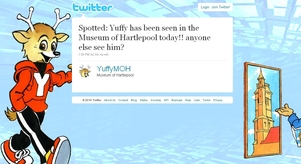
Yuffy on twitter
Yuffy tweets about all sorts of topics, with some of his tweets being marketing in tone. However, it was decided from the inset that his tweets should be relevant to his followers and therefore should contribute to the conversations already taking place. We need to be sociable and not simply broadcast, but create content that will be interesting for all.
How do people use Twitter?
When researching how Twitter is used, there were several examples that struck me as key to how people use and perceive Twitter. The examples below encouraged me to look at Twitter in a new way and influenced how I use Twitter for the museum.
After a nasty election in 2009, the people in the Iranian capital Tehran took to the streets in protest. The government then put a media ban on the protest. No-one was allowed in to the country to report on the protests, where police were imprisoning protesters and even shooting at them. The protesters turned to Twitter to get the message out. People across the globe took up the cause and tweeted safe areas in Tehran for protesters to go and news stations used Twitter to get information and videos to use in their broadcasts. Twitter allowed the protesters and the world to find out about the protest and atrocities happening to the people in an otherwise media blackout.
In May 2008 a massive 7.9 magnitude earthquake hit mainland China. While it was still happening, ordinary people were reporting it. They were texting on their phones, taking pictures and videos, and adding these to Twitter. It was a tweet that announced the quake online, several minutes before the US Geological Survey had anything up online for people to read. Twitter is the newest and fastest news feed the world has ever seen. In fact, the USGS have learnt from the China Earthquake and are piloting a new programme that maps tweets about earthquakes. The more people that tweet about an earthquake in a particular area, the more reliable the information and the USGS can make an announcement. The hope is to increase the alert time for local residents and possibly even save lives.
Twitter has even been used to free someone from jail. In April 2008, James Karl Buck and his translator were arrested by the Egyptian police while covering an anti-government protest in Mahalla. James was only able to tweet one word while being taken away by Egyptian authorities: “Arrested.” Within seconds, colleagues in the United States and his friends in Egypt were notified of his arrest. Eventually this lead to his university hiring a lawyer on his behalf and he was released a day later. This is proof that one update, no matter how simple, can mobilise people to action and change the course of events.

Yuffy on the high seas
But it’s not just on a national sphere, some tweets are very personal. From marriage proposals to births, people can now tweet at every part of their lives. On May 28th 2010, Max Kiesler asked Emily Chang for her hand in marriage via Twitter. And with a “Yes, I do”, similarly tweeted she accepted his proposal. This beautiful moment in a couple’s lives was shared by their followers across the globe. In fact there have been at least 3 (successful) marriage proposals.
These examples had thousands of tweets about the topic, or articles written about them. Tweets no matter how big or small attract the attention of users from all over the world and are commented upon. Learning how people use Twitter enables museums to understand the potential of Twitter and ways we can use the social media platform to communication with our users.
Tapping into the Potential

Yuffy out and about
How can museums then ‘tap into’ this potential community? There are many websites and resources out there giving you advice about how you can use Twitter. I approached this from two places: a museum and an individual. I use Twitter personally and therefore can understand what I want from museum Twitter streams. There are a few simple guidelines I would follow when using Twitter as an organisation.
- Be active. What is the point of being on Twitter if you do not update? People follow you on Twitter to read what you are continuing to say. So you need to make sure your stream remains active with tweets happening at least once a day.
- Be informal. Nobody wants their Twitter stream filled with automated, impersonal tweets. People go to Twitter to talk to other people, from all sorts of backgrounds, cultures and places. They want REAL conversations with REAL people. So you need to be a real person, who has a name, has a tone of voice and reacts to what they are seeing.
- Be a part of it. Don’t just broadcast your message. Although a useful tool for doing so, you will turn away followers who want to engage with you. Talk to your followers. Ask them for advice or comments, you’ll be surprised by the responses you get.
- Be prepared. Have at least some sort of guidelines in place when you start out. These will help identify issues and ways to deal with them. But remember, Twitter is constantly changing, so you’re guidelines must be able to change too. I started with a half page guidance for Twitter. Over the past year, this has developed into a 16 page strategy.
- Connect. If you run several of accounts on different platforms, it can become a laborious job to update them all. Twitter is useful in that it can be linked to other social media sites like YouTube, Facebook and Audioboo so you only need to add it to one place and it goes to Twitter too! Although make sure you don’t fill your Twitter stream completely with this type of material. You need Twitter-only created content too.
- Have fun! The last thing you want is to feel dread at the thought of writing a tweet. It needs to flow freely. So remember to have a little fun with your tweets. If you’re having fun and enjoying what you are writing, your followers will be too.
Don’t be afraid to join
Museums are only just starting to realise the potential of Twitter and how it can extend the reach of your message. You can converse with people on their terms, where they feel comfortable. This can be scary for organisations who are more accustomed to presenting information than having conversations with people. But people are already talking about your museum online. They are telling people about the experiences they had (good or bad) and stories they know about objects and the museum. Twitter allows you to take part in these conversations and part the knowledge we have about our museums in a new way.
Museums should not be frightened about going on Twitter and listening to what people are saying about your organisation. Remember people are already having these conversations so why not participate too?
September 9th, 2010 at 10:59 am
[...] This post was mentioned on Twitter by Mies Langelaar, Tweet Know-how. Tweet Know-how said: From Blogs: Cultural Heritage » Blog Archive » Museums as Social Creatures: Shona specialises in e-Learnin… http://bit.ly/cGb1rO #twitter [...]